News
Photo Credit: Ze Wei
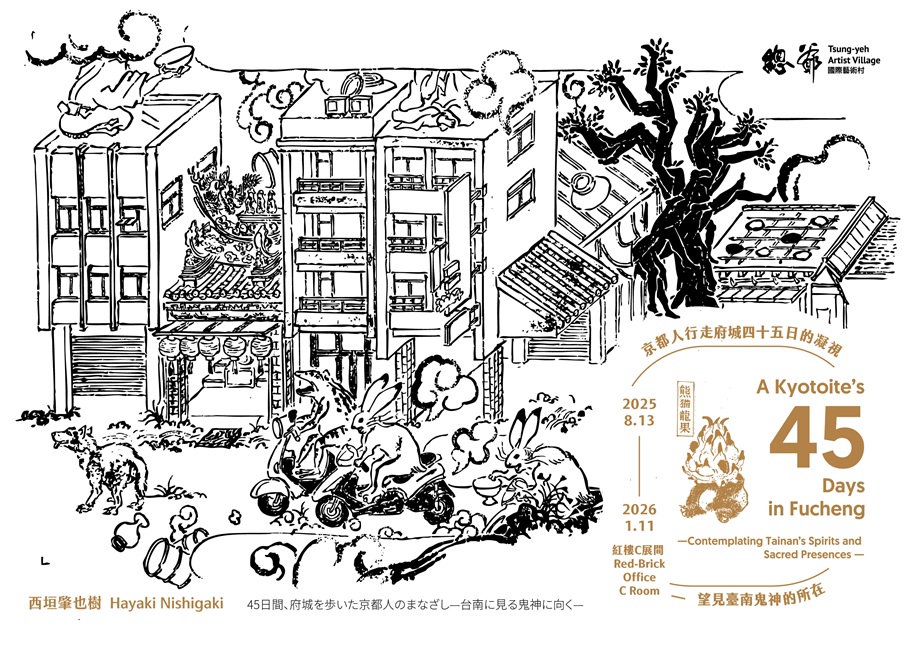
Hayaki Nishigaki Solo Exhibition: A Kyotoite’s Gaze After 45 Days in Fucheng— Contemplating the Sacred and the Unseen in Tainan —
2025/08/13
Date:2025/04/25-07/27
Time:Wed.-Sun. 09:00-17:00
Since time immemorial, serpents and dragons have been revered as sacred beings pre-siding over rivers and waterways—symbols of both royal authority and the untamed power of nature. In China, dragons are more commonly seen; while in Tainan, the Zengwen River was once called the “Qing-Ming Snake,” a blind, rampaging serpent whose unpredictable movements brought floods and reshaped waterways time and again.
This ancient relationship between humans and nature began to shift during the Japanese colonial period. With the construction of the Wushantou Reservoir and the Chianan Irri-gation System by engineer Yoichi Hatta, the land became fertile. The later completion of the Zengwen Reservoir and the reinforcement of flood-control embankments allowed the river to be effectively governed. In this transformation, the bond between nature—as divine presence—and humankind was profoundly reconfigured.
Meanwhile, Taiwan’s modern era gave rise to a series of female ghost legends. Among them are figures like Chen Shou-niang (陳守娘), who was sold and later exe-cuted for resisting sexual coercion, and Sister Lin-Tou (Lin-Tou Jie, 林投姐), who end-ed her life beneath a screw pine tree after enduring betrayal. Their unresolved anguish took shape as supernatural presences—stories born of sorrow, yet infused with awe. Over time, they came to be venerated as ghost-deities (guishen, 鬼神), gathering both fear and prayer from those who remembered them.
Their stories often reveal the heartbreak caused by male betrayal, and the lack of chan-nels for women to seek justice within society. Many were driven to vengeance as a way of claiming moral or cosmic redress.
Even in cases like this, those who are neither saints nor nobility—ordinary, nameless individuals—may become objects of worship. Their pain, unheeded in life, is trans-formed into spiritual presence in death.
I find echoes of these ghostly women in Japan’s Godzilla—a creature born of nuclear experimentation, a manifestation of modern humanity’s unbridled science and desire. In many ways, Godzilla can be seen as a contemporary god: terrifying, untouchable, and born from our own hands.
The rituals meant to appease the ghost-deities and the anxious vigilance with which people watch over unstable nuclear reactors, both reflect a similar emotional stance—one shaped by awe and reverence toward forces beyond human control.
Once, we trembled before the great serpents and dragons that embodied nature itself. But over time, our gaze has shifted. Today, we glimpse ghost-deities not only in the wild, but also in the things we have created—in technology, in revenge, in injustice, and in desire.
Yet nature still reminds us of its presence. Disasters like Typhoon Danas continue to strike with overwhelming force, conjuring the image of a dragon in fury—proof that the ancient wildness has never truly disappeared.
Now, standing in Tainan, I find myself layering together vast nature, hydraulic engi-neering, the ebb and flow of human civilization, the presence of female ghosts, and the shadow of Godzilla. Through this convergence, I attempt to draw a contemporary aerial map—one that traces the entangled contours of this intricate landscape.
More Information:
https://tyart.tnc.gov.tw/index.php?inter=program&period=real&id=254