News
Photo Credit: Ze Wei
【Taiwan Literature Base】WiR Regular Activity | Living in Truth
2025/05/20
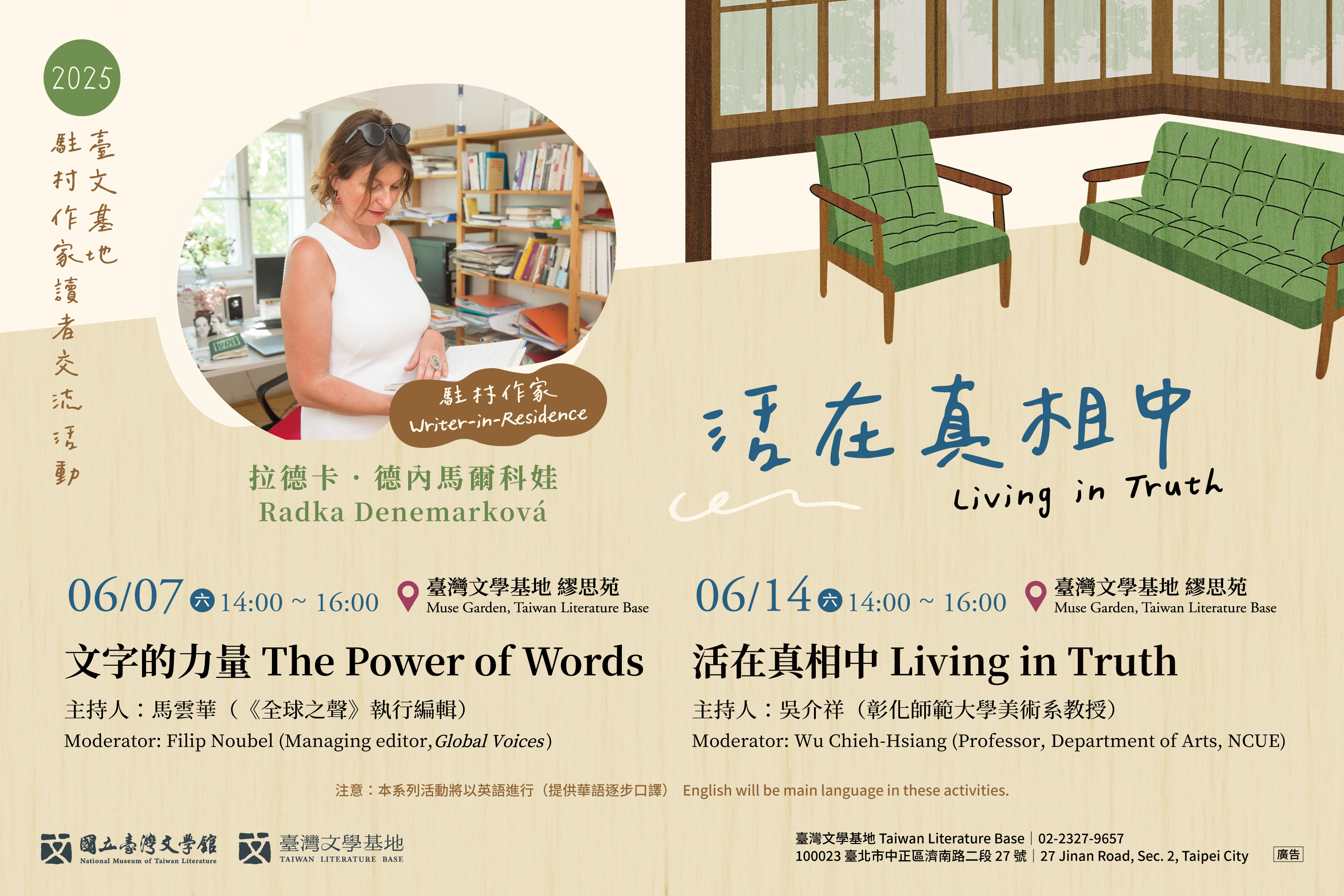
Her works of fiction are attempts to uncover – in narrative prose marked by a distinctively poetic style – the key nodes of power in human relationships, intimate as well as political. In all her literary activities she consistently takes a stand, interweaving fiction and fact to create compelling portraits of society and deals with current issues as well as with some of the dark and suppressed sides of European history. She rebels against all totalitarianisms and patriarchal structures and gives victims a voice. Her books have been translated into twenty languages to date.
She is the only four-time winner of the prestigious Czech literary prize, Magnesia Litera, and what is particularly significant, in four different categories: the Best Prose of the Year for Money from Hitler in 2007, the Best Book in Journalism for The Story of Petr Lébl in 2008, the Best Translation of the Year for Herta Müller's prose Atemschaukel in 2011 and the Book of the Year 2019 for Hours of Lead. This 800-page critically acclaimed novel set in contemporary China was also awarded in Germany and Austria. The author was punished with a lifetime ban from entering China. In 2024, Dr. Denemarková received the State Medal of Merit of the President of the Czech Republic, the Austrian Franz Kafka Prize and the European Tolerance Award.
During the residency, she plans to complete the part of her long novel with the working title "Nanning Street". It is an extensive novel that traces the parallel history of families in Taiwan and Czech Republic, Prague. It is also an exploration of democracy (which began in Taiwan in 1989 and in the Czech Republic/East Europe in 1989) and human rights and their defense. The novel will be a panorama of historical and current events in Taiwan and the Czech Republic. It follows on from her large-scale successful novel Hours of Lead, where she touches on the issues and dangers of modern-day totalitarianism in a wider and global context and warn of the dangers of modern-day totalitarianism. She cooperates with journalist Filip Noubel, editor-in-chief of Global Voices, who lives in Taipei, speaks Czech and Taiwanese with documentary (feature film for cinemas) about the position of literature in today's world and Radka Denemarková's relationship to Taiwan.
Session 1:The Power of Words
Date:June 7th (Sat.) 2PM - 4PM
Venue:Muse Garden, Taiwan Literature Base
Moderator:Filip Noubel (Managing editor, Global Voices)
"A book must be an ice axe to break the sea frozen inside us."
The term "Kafkaesque" has entered common usage, referring to the absurd, grotesque comedy in his work. Are we living in a Kafka world? What is the power of literature today?
Have we learned from the twentieth century?
Meet Czech writer, Radka Denemarková, four-time winner of the Magnesia Litera Award. This event presents an opportunity to hear the excerpts of her bestselling books: Money from Hitler, Contribution to the History of Joy and Hours of Lead. Delve into her thoughts about the contemporary European literary scene and the power mechanisms of modern society in connection with the anniversary of the end of World War II, through a discussion moderated by Filip Noubel.
"Literature has only one task: not to be afraid and not to lie. For me, literature is a part of life, for me it is the sum of all forms of courage, art, friendship and thinking that allow a person not to be a slave. The purest form of love for life." – Radka Denemarková
Session 2:Living in Truth
Date:June 14th (Sat.) 2PM - 4PM
Venue:Muse Garden, Taiwan Literature Base
Moderator:Wu Chieh-Hsiang (Professor, Department of Arts, NCUE)
How are the fates of Taiwan and the Czech Republic similar? What are the differences between democracy in Taiwan and Europe? Truth, courage, literature and politics in the time of Václav Havel and today. Education, science and research are so central to finding the truth, to the well-being of the community and to a vibrant democracy. About the book of Taiwan, whose history is in many ways parallel to the history of the Czech Republic. These are forms of the struggle for democracy and humanism, through a discussion moderated by professor in the Department of Arts at the National Changhua University of Education in Taiwan, Wu Chieh-Hsiang.
More Information:
https://event.culture.tw/mocweb/reg/NMTL/Detail.init.ctr?actId=50096&request_locale=en&useLanguage=en